































 Post by
7 Proven Ways CAD Productivity Transforms Engineering Lead Time
CAD productivity is the most effective lever for reducing engineering lead time in 2026, especially for organizations managing complex products, high variant volumes, and aggressive delivery targets.
Across aerospace, industrial equipment, energy systems, and capital machinery, engineering teams face the same pressure: deliver faster, handle more customization, and maintain quality without proportional growth in resources.
Product complexity is rising. Variants are increasing. Customization is now expected.
Yet engineering teams are already operating near capacity.
The fastest way global OEMs and Tier-1 suppliers are closing this gap is not by adding headcount it is by improving how design work is executed inside CAD systems through automation and embedded intelligence.
Where Engineering Time Is Really Lost
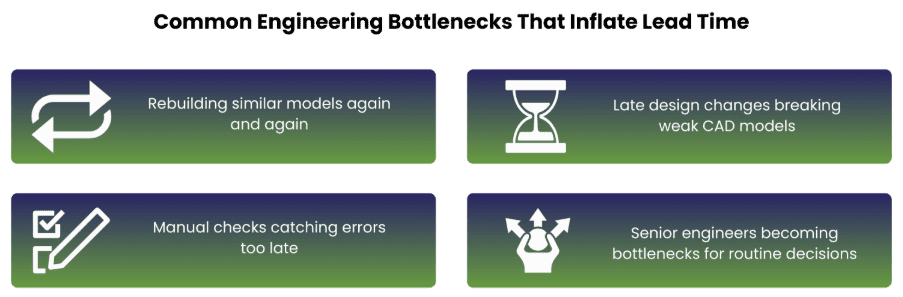
Engineering delays rarely come from a single failure. They build up through everyday inefficiencies inside design workflows, such as:
- Rebuilding similar CAD models repeatedly across projects
- Late design changes breaking weak or poorly structured models
- Manual checks detecting errors only at the end of development
- Senior engineers becoming bottlenecks for routine decisions
These are not skill issues.
They are system problems.
Without embedded engineering intelligence, CAD environments rely heavily on manual repetition and individual experience an approach that does not scale across teams, programs, or geographies.
What High-Productivity CAD Workflows Really Mean
High-performing CAD workflows are not about modeling faster.
They are about building engineering systems that execute decisions automatically and consistently.
Effective design environments:
- Reuse proven engineering knowledge instead of recreating it
- Absorb late design changes without model collapse
- Prevent errors rather than detecting them downstream
- Deliver predictable outputs across teams and locations
This approach aligns closely with Knowledge-Based Engineering (KBE), where engineering logic is embedded directly into design systems.
How Modern CAD Efficiency Is Enabled
Leading engineering organizations embed productivity directly into CAD using focused, domain-specific toolkits rather than broad, generic customization.
Eliminating Repetitive Modeling
Parametric and rule-driven toolkits automate common geometry and feature creation, removing repetitive modeling effort and reducing dependency on individual expertise.
- BIW fixture layout automation
- Industrial equipment configuration
- Boiler and pressure vessel design automation
Strengthening CAD Models Against Late Changes
Weak CAD structures are a major cause of rework. Engineering throughput improves when design intent and validation rules are enforced early.
- Model health and design-intent enforcement
- Clearance and interference validation
- Tool reach and manufacturability checks
Reducing Manual Checks and Late Errors
Manual quality checks slow teams down and catch issues too late.
Automated validation ensures quality continuously throughout the design lifecycle.
Freeing Senior Engineers for High-Value Work
Automation shifts routine execution away from experts, allowing senior engineers to focus on innovation, optimization, and complex problem-solving.
Accelerating Drafting and Documentation
Drafting and documentation remain major hidden time sinks in many organizations, especially during late-stage changes.
- Intelligent drafting automation
- Automated drawing generation
- Dimension extraction
- Metadata and data export automation
What High-Efficiency CAD Systems Deliver in Practice
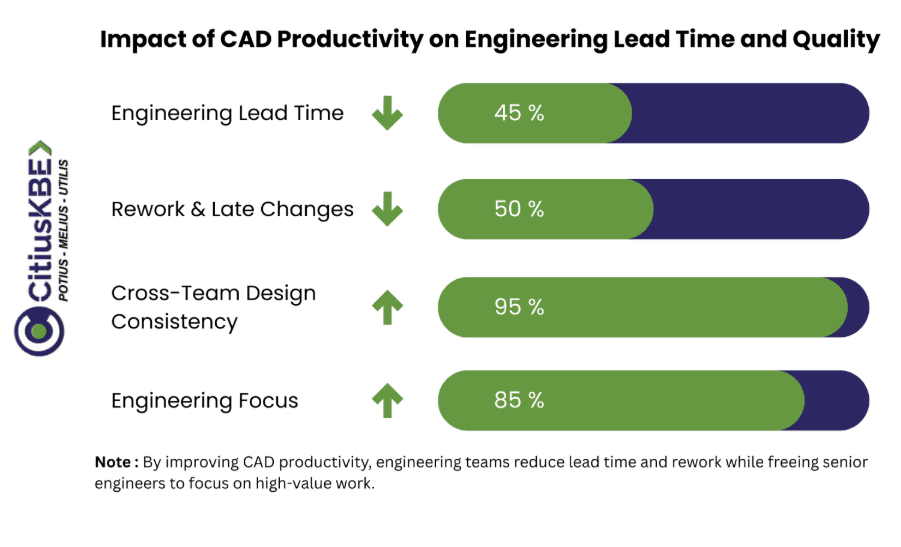
Across global OEMs and Tier-1 suppliers, CAD-led improvement programs consistently achieve:
- 30–60% reduction in engineering lead time
- Significant reduction in rework and late changes
- Higher consistency across distributed teams
- Better utilization of senior engineering expertise
Most importantly, teams stop firefighting and start engineering.
How CitiusKBE Builds Sustainable Engineering Productivity
CitiusKBE treats productivity inside CAD as a long-term engineering capability rather than a one-time customization effort.
The approach includes:
- Identifying high-impact repetitive workflows
- Capturing real engineering knowledge into reusable logic
- Deploying modular automation toolkits incrementally
- Ensuring scalability, maintainability, and CAD-native performance
Platform-level support includes:
- Admin and configuration management
- CAD data discovery and reuse
- Import correction and cleanup
- CAD standards enforcement
The Bottom Line
Engineering lead time is no longer just a planning problem.
It is a CAD productivity problem.
Organizations that embed engineering knowledge, automation, and validation directly into CAD workflows achieve faster releases, higher quality, and sustainable scale.